POST-HIERARCHICAL ANALYSIS · 017
Who manufactures impossibility — and who can undo it?
A post-hierarchical analysis of Austina Pakalnytė’s conversation with philosopher Kristupas Sabolius
Terms marked ? are explained without leaving the article.
‘Nothing can be changed’ may sound like a sober conclusion about the world. Sometimes, however, it describes more accurately an arrangement in which people have no opportunity to explore together what could be changed and how. When the search for solutions is closed off, its absence begins to look like evidence that no solutions exist.
Publication: Read the original conversation →
SHORT EXPLAINER · 1 MIN 21 SEC
How to Dismantle Artificial Impossibility
A claim that change is impossible may reflect how the search is organised. Collective decidement lets people develop and assess alternatives that existing procedures leave unexplored.
- A verified constraint differs from an unexplored possibility.
- Organisational rules can close off the search for alternatives.
- Participants in collective decidement propose and assess ideas.
- The selected option is tested in practice.
A conversation about possibilities being closed off
Austina Pakalnytė’s interviewee, philosopher Kristupas Sabolius, explains ecosociality through the connections between nature, society, technology and war. The conversation follows the conference ‘Ecosocial Ideas: Coexistence and Change’, organised by Vilnius University’s Centre for Research on (Post)Authoritarian Landscapes. The term counter-affordances describes possibilities that are actively blocked. Uncertainty is also examined as a means of entrenching the belief that action is impossible.
Framing the problem this way raises an institutional question: who has the right to decide that the possibilities have been exhausted? Does that conclusion emerge from a sufficiently broad search, or from an arrangement in which only a few are allowed to search? The post-hierarchical analysis below examines precisely this distinction.
What the conversation brings into view
Problems cross the boundaries between fields
Sabolius connects ecological, social and political circumstances. This helps reveal what an isolated, single-field perspective misses.
Constraints can be actively produced
The blocking of possibilities is discussed as an activity that changes people’s experience and behaviour. Powerlessness consequently ceases to look like a purely individual condition.
Real danger is distinguished from its instrumentalisation
The interviewee separates a concrete threat from politically amplified uncertainty. This distinction matters: critical thinking must not turn into a denial of danger.
Where the post-hierarchical contribution begins
To recognise the blocking of possibilities and seek a prospect for action even where a sense of impossibility is being entrenched.
To create a decision-making architecture in which people with different experiences can jointly develop and assess alternatives, with a predefined connection between their results and the decision ultimately made.
A philosophical conversation need not supply a complete organisational model. Yet such a model is needed to bring the question it opens into practice. The collective decidement proposed here — the search for and selection of solutions — is an independent contribution by culture.lt, not a prescription attributed to Sabolius.
A possibility becomes testable in practice when people have a way to construct it together.
Who has the right to say ‘impossible’?
Imagine an organisation where proposals for change are met with familiar responses: there is not enough money, people will never agree, the requirements are incompatible. Each claim may be well founded. Yet each may also conceal an untested assumption: that every worthwhile alternative has already been considered.
A budget sets out how much can currently be spent. It does not, by itself, tell us which combinations of activities are worth trying. Disagreement shows that participants assess the existing options differently. It does not prove that there is no as-yet-uncreated solution that would change the choice itself. A constraint identified by a specialist may be fundamental, but we still need to understand exactly which part of the proposed action it limits.
Post-hierarchical analysis examines the arrangements through which such claims become final. If the same centre defines the problem, selects the alternatives to be considered and declares that no better ones exist, a closed circle of knowledge forms. Knowledge outside it cannot test the conclusion, even though those reaching it may be acting entirely in good faith.
Impossibility can therefore also be sustained by ordinary routines: one department protects its budget, another meets its targets, a third avoids responsibility for a trial. No single, deliberately manipulative actor is required for a shared search to be left without a place or anyone responsible for it.
Three different forms of impossibility
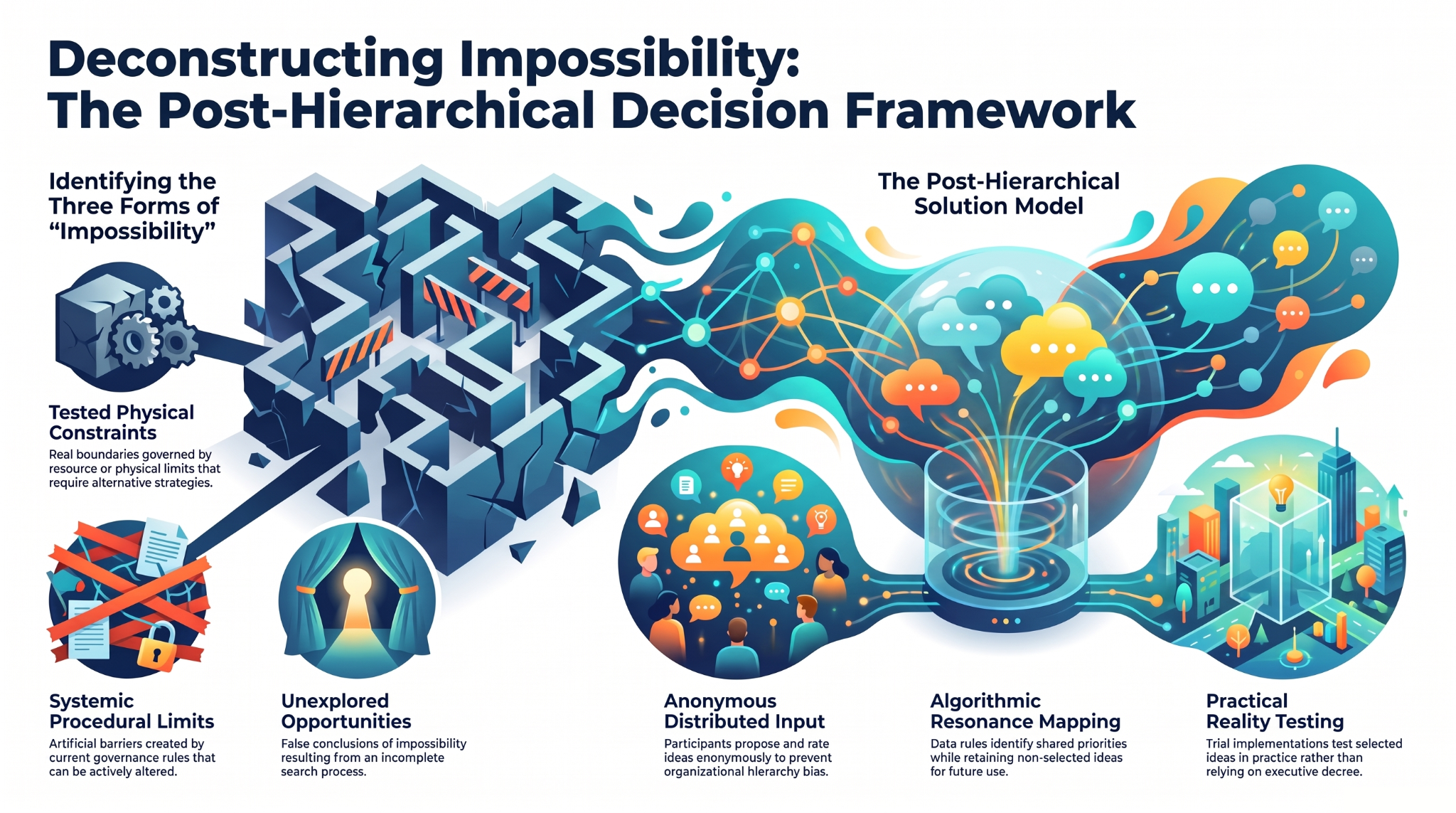
To open up the search, it helps first to distinguish what we mean by impossibility. This analysis proposes three cases.
- A verified constraint. A particular action conflicts with established physical conditions or exceeds the resources available. A different action, other resources or a longer timeframe must be sought; the fact itself cannot be voted away.
- A constraint imposed by the existing arrangement. Action is prevented by the chosen model of procedures, responsibilities or resource allocation. Changes to that model must therefore also be considered, with a clear account of who has the authority to make them.
- An unexplored possibility. We do not yet have a solution, and previous attempts have not helped. This gives us grounds to refine the question and widen the search. A conclusion of universal impossibility would go beyond what we know.
These situations can overlap. One of the most useful steps is therefore to break the blanket answer ‘we cannot’ into testable claims: what exactly can we not do, under what conditions, on what grounds do we know this, and what new information would allow the conclusion to be revised?
How distributed knowledge becomes a shared search
begins with the opportunity to help create what will later be assessed. An invitation to choose between two prepared options may be useful, but it does not allow a third to be proposed. Asking questions at a meeting likewise does not guarantee that the different answers will develop into a shared solution.
In a environment, people interact on a single platform: they read other participants’ proposals, assess them and contribute their own ideas. Another participant’s observation can change not only the answer selected, but also the understanding of what kind of answer to seek. The initial options may give rise to a new combination that nobody proposed at the outset.
is important here. Assessing a proposal should not require choosing between its substance and loyalty to a manager, colleague or one’s own camp. At the same time, each person’s contribution is recorded: anonymity in this architecture does not turn interaction into an indistinguishable stream of opinions.
Competence remains important. A specialist may spot a technical error, while someone who encounters the problem every day may show why a formally suitable solution does not work. Their interaction is intended to strengthen the shared capacity to solve problems. A job title alone should not determine in advance whose proposal is more valuable.
People assess ideas, while the algorithm calculates the results according to established rules. helps reveal where a shared assessment is forming and where disagreement remains. Ideas receiving less support should not be deleted: when circumstances change or new arguments emerge, they may become material for a new search.
The shared home also includes those who do not participate
Once decidement is opened up, we must still ask who has been left out. The most active participants do not necessarily represent all groups affected by a decision. Future residents are not participating, and ecosystems do not state their needs in an idea written by a human being.
Preparing the task therefore requires access to knowledge about long-term impacts, the experiences of less visible people and the condition of the environment. Participants must be able to examine the evidence behind a claim of shared benefit and identify who would bear its cost. Agreement alone does not confirm that every consequence has been noticed.
The maturity of post-hierarchical decidement would be demonstrated by the ability to revisit the question itself when something important turns out to have been left outside its scope. Openness would then be a continually maintained property of the process.
How to turn impossibility into a decidement task
Imagine a hypothetical situation: a library has an inner courtyard, but its use keeps being postponed because of neighbours’ peace and quiet, accessibility, the protection of planting and a limited budget. Staff begin saying that reconciling everyone’s needs is impossible. This example explains the process; it does not describe an actual project.
1. Preparation: clarify the problem and its boundaries
First, information would be gathered about the space, its conditions of use, available funds and the difficulties people experience. Constraints based on verified requirements would be distinguished from organisational choices made in the past. Neighbours, visitors, library staff, accessibility specialists and environmental specialists would be invited.
One possible question:
What single change in the use of the library courtyard over the coming season would create the greatest shared benefit, taking account of accessibility, neighbours’ peace and quiet, the protection of planting and the available budget?
Participants agree in advance who can make the final decision, what resources would be available for a trial and how they will learn what happened to their proposals. This preparation establishes the conditions for collective decidement.
2. Collective decidement: assess, propose and keep searching
On a single interactive platform, a participant would first assess the ideas of others presented to them, and could then submit a proposal of their own. Each proposal would contain one clearly formulated idea. Interaction would take place under accountable anonymity, while the system recorded contributions through both ideas and assessment.
Assessing others’ proposals might reveal that the conflict arises not from opening the courtyard itself, but from the timing of activities, the location of the entrance or the chosen event format. New ideas would then change those combinations. If a fundamentally different underlying problem emerged, a separate task would be prepared for it.
The algorithm would calculate the collective assessment of alternatives. The result would show which proposals the group regards as most valuable and where further clarification is needed. AI could help participants find starting points for ideas, but responsibility for assessing proposals would remain with people.
3. After decidement: the decision and its verification
If the library retained conventional hierarchical governance, authorised managers would make the final decision through the procedure agreed in advance. They would need to explain their choice, particularly if it differed from the outcome of the collective search. Using collective intelligence in such an organisation does not, by itself, change its form of governance.
The selected change would be tried out. The organisation would observe who uses the space, who still cannot access it, how neighbours’ experiences change and whether the agreed conditions are respected. Implementation and impact assessment would take place after collective decidement. New evidence could become the starting point for its next cycle.
VIDEO ESSAY · 8 MIN 57 SEC
Deconstruct Impossibility
A visual exploration of the article’s central question: how uncertainty becomes a conviction that action is impossible, and how developing and assessing alternatives together can reopen the search for solutions.
When does participation actually change the decision-making arrangement?
If an organisation invites people to develop alternatives but can subsequently ignore them without explanation, it risks reinforcing the very powerlessness it sought to reduce. A person now knows that making proposals is possible, yet also learns that proposing makes no difference. The connection between the outcome of the search and the decision is therefore an essential part of the process.
Different institutional agreements are possible. In one case, the collective search produces recommendations, while managers retain the right and responsibility to choose. In another, an organisation commits in advance to implementing the outcome of collective decidement within a defined area. Participants need to know which model they are working in.
In , collective decidement would include making the final decision. Implementation would remain a matter of specific functions, competences and responsibilities: specialists would organise how to carry out the collectively chosen direction. If a major obstacle emerged, it would provide grounds for reviewing the decision through the established procedure.
This makes it possible to begin with one real change while seeing its limits clearly. Introducing a shared search is a step towards post-hierarchy; how far it changes power itself depends on who holds the final choice and under what rules.
A possibility must withstand reality
Collective assessment does not automatically turn an attractive idea into a workable solution. A group may overlook an important circumstance, rely on incomplete evidence or estimate costs too optimistically. Opening a possibility must therefore be followed by testing it.
A practical trial provides something that neither authority nor an algorithmic result can supply: knowledge of how a particular solution works. Failure can then be broken down into causes rather than turned into another universal verdict. We learn which option did not work, under what conditions and why.
From this perspective, post-hierarchical architecture would be an arrangement for learning. Its value would lie in generating more well-grounded alternatives, selecting promising ones and adjusting direction in light of experience. Promising that all conflicts will disappear or that the best solution will always be found would only make such learning harder.
AUDIO ESSAY · 19 MIN 35 SEC
How Bureaucracy Manufactures Impossibility
An audio discussion of institutional barriers and collective decidement: distinguishing genuine constraints from established routines, opening up alternatives and connecting the outcome of a shared search to action.
Who has the right to open up a possibility?
The claim ‘impossible’ deserves a question about the conditions of the search. Who could propose? What knowledge was included? Who assessed the alternatives? Could the problem itself be reformulated? The answers reveal how much the conclusion tells us about reality, and how much about the limits of our chosen arrangements.
Impossibility can be sustained by a monopolised right to define what is worth considering at all. It can be reduced by distributing a real opportunity to take part in a shared search for solutions and connecting its outcome to action.
When people can construct and test alternatives together, the future becomes a shared task of decidement.
Where possibility closes and where it opens
flowchart TD
          A["Uncertainty and constraints"] --> B{"How is the search organised?"}
          B -->|"The search is closed"| C["An unexplored possibility is deemed impossible"]
          C --> D["Powerlessness and inaction"]
          B -->|"Post-hierarchical contribution"| E["Clarify boundaries and the shared question"]
          E --> F["Participants develop and assess alternatives"]
          F --> G["The algorithm calculates results"]
          G --> H["Decision under agreed authority"]
          H --> I["Implementation and verification"]
          I -->|"New evidence"| E
          classDef closed fill:#f3f1ec,stroke:#9b978f,color:#25261f
          classDef post fill:#fff8f4,stroke:#a93b2b,color:#25261f,stroke-width:2px
          class A,B,C,D,H,I closed
          class E,F,G post