POST-HIERARCHICAL ANALYSIS · 022 · 27 November 2026
Why Read If Others Decide?
A post-hierarchical analysis of Vita Vilimaitė Lefebvre Delattre’s interview with Marija Antanavičiūtė
Terms marked with ? can be explained without leaving the article.
Marija Antanavičiūtė warns that if we stop reading and writing, we will lose our capacity to decide democratically. But might causality also run in the opposite direction? If society is given mainly the right to choose those who will decide on its behalf, why should it care about developing its own capacity for decidement? And if collective intelligence enabled society itself to take over the function of professional politics, might reading and writing acquire a new social meaning?
Publication: Read the original interview →
SHORT VIDEO · 1 MIN 23 SEC
How Collective Decidement Replaces Politicians
What if society no longer needed permanent political intermediaries to discover and choose solutions?
- From delegated political power to collective decidement.
- The relationship between independent thinking, competence and real decision-making power.
Seven Marches and the Question of How to Live Together
The occasion for Vita Vilimaitė Lefebvre Delattre’s interview is Kovai (2026), a new collection of essays by Marija Antanavičiūtė, a writer with a doctorate in social sciences. Seven essays cover the months of March from 2020 to 2026: the pandemic, war, social tensions and everyday personal life. In the interview, these experiences are linked to the future of democracy, technological ethics, loneliness and the importance of living human connection. [1]
Two themes intersect here that we usually consider separately: who has the right to decide, and who has the ability to decide. The first belongs to political theory, the second to education, culture and the philosophy of cognition. Antanavičiūtė’s interview provides an opportunity to examine them as a single problem.
Context: Democracy Between Representation and the Delegation of Thinking
Representative democracy gives political legitimacy to a division of labour: citizens grant a mandate, politicians decide, and the administration implements. Such a model had understandable reasons at a time when a large society could not continuously exchange knowledge and deliberate together on thousands of complex questions. Today, however, digital technologies make it possible to organize interaction that need not occur in a single room or pass through permanent representatives.
At the same time, a new form of delegation has emerged. Generative artificial intelligence (AI) can take over not only routine work but also reading texts, producing summaries and formulating arguments. The delegation of political decisions can thus coincide with the delegation of cognitive activity. In one case another person decides for us; in the other, technology may begin to shape what we consider our own thoughts.
Delegation brings benefits in both cases. The danger arises when an aid begins to replace the very subject it was supposed to assist. This is precisely where the political problem becomes a cultural one: literacy is no longer merely the ability to read or write a text. It is the capacity to participate in creating the rules of our shared life.
What Makes Antanavičiūtė’s Perspective Valuable?
The political profession is distinguished from the ability to decide
Drawing on Hélène Landemore’s idea of citizens’ assemblies, the interview questions the cognitive superiority of professional politicians.
Democracy is not reduced to procedures
Participation requires patience, trust and the ability to recognize the dignity of others.
Social ethics is connected with evidence
Jane Addams’s tradition of social ethics and scientific research into the effects of policies make it possible to consider not only intentions but also the actual value of assistance.
The question of technology is returned to society
The interviewee warns of the weakening of independent thinking and of the mismatch between technology companies’ interests and public welfare. [1]
Where the Interview Ends and the Post-Hierarchical Analysis Begins
Democracy requires citizens who can think and act in socially responsible ways; they must be given greater opportunities to participate in governing society.
Change not merely the scale of citizen participation but the architecture of decidement itself: enable people themselves to discover, evaluate and choose solutions.
What follows develops the culture.lt post-hierarchical proposal, connecting the problem of cognitive capacities raised by Antanavičiūtė with the omnicracy model and the latest Post-Hierarchy Papers publication on the future of professional politics. [3] This proposal is not a model attributed to Antanavičiūtė or Landemore.
What If Democracy’s Crisis Does Not Begin When We Close a Book?
The weakening of independent thinking may undermine democracy. But the monopolization of decisions may also weaken society’s motivation to think independently.
Imagine someone who takes a sustained interest in the future of their city. They read urban planning research, analyse public transport routes, look for the experiences of comparable cities and even devise a better alternative. What can they do with it? Write a comment, send a letter to the municipality, take part in a consultation, try to influence a politician. Yet the final decision usually does not depend on how valuable the idea they discovered is. It depends on the institution empowered to accept or reject it.
A person whose knowledge never becomes part of a shared decision may stop investing time in deepening it. It becomes more rational for them to follow the struggle between political camps, adopt one camp’s narrative or simply disengage. Reading remains an activity of personal development, but its connection with a real opportunity to change shared reality is severed.
This is not a claim that representative democracy necessarily causes illiteracy or that people have no other reasons to read. It is a hypothesis about the incentives shaped by institutions. If the ability to think develops through use, a society given few opportunities to decide for itself loses one of the most important arenas for that development.
A society does not become a thinking society simply because it is allowed to elect a thinking leader.
Politics Without Politicians: Is Drawing Lots Enough?
The direction proposed in Landemore’s book Politics Without Politicians: The Case for Citizen Rule (2026) marks an important shift: decision-making power could belong to people temporarily selected by lot rather than to a class of professional politicians. [2] Sortition can reduce dependence on election campaigns, money, public visibility and political career ambitions.
Yet sortition mainly addresses the question of participant selection. In itself, it does not explain how to discover an alternative that does not yet exist, how to incorporate distributed specialized knowledge, how to draw on the insights of thousands of people or how to ensure that a quiet argument is not outweighed by an eloquent but weak one.
Citizens’ assemblies can consult experts, learn, deliberate and be empowered to make decisions. Nevertheless, even a decision-making assembly remains a group of limited size if its members develop and choose alternatives internally on behalf of everyone else. Its representativeness is not yet the collective intelligence of society as a whole.
raises a different question: must we still assemble a group entrusted with deciding for others? Might it suffice to organize separate interactions tailored to particular problems, in which anyone can participate according to their competence and the relevance of the decision to their life?
Here a distinction opens up between a randomly selected citizen temporarily granted representative power and a person knowledgeable about a particular issue whose competence helps expand the range of possibilities available to everyone. Sortition may also be useful in post-hierarchy, for example when forming a sufficiently diverse group from people with the relevant competences. But drawing lots must not replace the decidement protocol.
This distinction is illuminated by the essay When Politicians Become Unemployed (No. 240), published in Post-Hierarchy Papers on 27 November 2026. [3] It advances the hypothesis that professional politics may lose its institutional necessity not because artificial intelligence replaces politicians, but because people learn to perform their decision-making function collectively. This is termed .
Thus, the approaches of Antanavičiūtė, Landemore and omnicracy highlight three distinct but related questions: how to preserve the thinking citizen, how to change the selection of those entitled to decide, and how to organize society’s decidement so that permanent political intermediaries are unnecessary. In the latter case, what changes is not merely the composition of those deciding but the very logic of political life.
The essential question is not who will replace politicians, but what architecture of human interaction could eliminate the need to make their function a permanent profession.
Two Tasks That Should Not Be Entrusted to the Same Authority
distinguishes two complementary stages. The first answers the question of which solutions are possible and valuable. The second asks which of them should be chosen for shared implementation. The competence to discover possibilities does not automatically grant the right to choose other people’s future. Both stages use collective intelligence: the same anonymous interaction environment and the same principle connecting an individual’s score with collective wisdom. What differs is the task and the competences it requires, not the logic of decidement itself.
Stage I. People Knowledgeable About the Issue Discover Alternatives
People with competences relevant to a particular problem join a shared environment. Competence is not limited to an academic degree: professional knowledge, local experience and the ability to discern consequences that are difficult to formalize also matter. New participants’ readiness can be assessed using a task-specific test, while the weight of their evaluations can be based on their accumulated in earlier activity. This is not a permanent title. The group is formed to address a particular problem, not to obtain a mandate to decide all future questions. Once its task is completed, it dissolves.
Participants operate under conditions of . Before submitting their own proposal, they review and evaluate those already submitted. Each entry expresses one clear idea. There is no need to defend one’s name, institution or political camp. Another person’s insight may help generate a new and better alternative.
The result of evaluation is not simply an expert verdict, but a ranked portfolio of alternatives showing the of proposals, the distribution of ratings and their . The aim is not merely to reconcile participants’ interests, but to discover solutions that also create value for those who did not participate. Even an idea receiving sharply divergent evaluations may be important: it may point to a new possibility, an unresolved tension between values or missing information.
Stage II. Stakeholders Choose a Solution
The second stage is not a vote in which each person indicates which alternative is most favourable to them personally. It is a new collective decidement task in the same collective-intelligence environment. The portfolio of alternatives discovered and ranked during Stage I becomes the object of shared evaluation. Under conditions of accountable anonymity, participants examine and evaluate all the alternatives presented, seeking to discover which solution would generate the greatest social value. The final choice emerges from the results of their collective evaluation, rather than from individual preferences or a contest between majority and minority camps.
Who may participate? Anyone who wishes to contribute to resolving the particular issue and has passed a in the domain in which the final decision will be made. Having a stake determines a person’s own decision to join the task, not whether an institution grants them permission to decide. No particular age, educational qualification, professional position, social status or group membership is required. What matters is not the person’s category but their actual ability to understand the issue. Stage II participants do not need the same narrow specialist knowledge that may be necessary to develop alternatives in Stage I: they need sufficient domain competence to understand the differences between them and their foreseeable consequences.
The test must be rapid so that participants do not have time to consult external sources of information or ask generative AI to answer for them. AI helps develop and support a domain-specific assessment of competence, rather than select people according to political views, social origins or presumed morality. The purpose is to ensure that the person answers independently and understands the problem being addressed. Accessible test formats must preserve the same requirement of independent answering. Such a test assesses readiness for a particular question; it is not a general measure of a person’s intelligence or worth.
The cultural significance of this principle is considerable. A young person with sufficient knowledge of an issue could take part in deciding it without waiting to reach a formally prescribed age. An older person would have no advantage simply because of age, just as a professor would have no advantage merely because of an academic title. The opportunity to decide would be acquired not on reaching a particular birthday or receiving a political mandate, but on acquiring competence relevant to the question. This is a principle of the proposed post-hierarchical architecture, not a description of existing voting rights.
How is a solution chosen? Stage II employs the same incentive principle as Stage I. A participant’s individual score depends on their ability to “align with collective wisdom”, which neither they nor anyone else knows before evaluation. In evaluating an alternative, a person not only seeks to discern the future collective assessment; through their own rating they also help create it. It is therefore rational to examine arguments closely, judge impartially, consistently follow universal values and principles, and anticipate long-term consequences not only for oneself but also for others. The pursuit of the highest personal score becomes an incentive to seek the best shared solution. Earlier culture.lt analyses described precisely this reversal of incentives as the . [4] [6]
The difference from an ordinary majority vote is fundamental. In voting, a person may seek victory for their interest group while leaving others to bear the costs. In collective decidement, such a strategy runs counter to the purpose of the protocol: individual success in evaluation is linked to a collectively discovered common good, rather than to the triumph of one’s own group. The aim is to choose a solution that benefits those who did not participate, could not participate or have not yet been born, while also taking account of nature, which cannot express its own interests. Competence becomes a resource for shared decidement rather than a monopoly of power.
The selected and ratified solution is passed to implementers. Its implementation and consequences are monitored, and if conditions change or new knowledge comes to light, a further decidement cycle may be initiated. This preserves the possibility of learning from reality even when a decision was made in good faith and on the basis of the best knowledge available at the time.
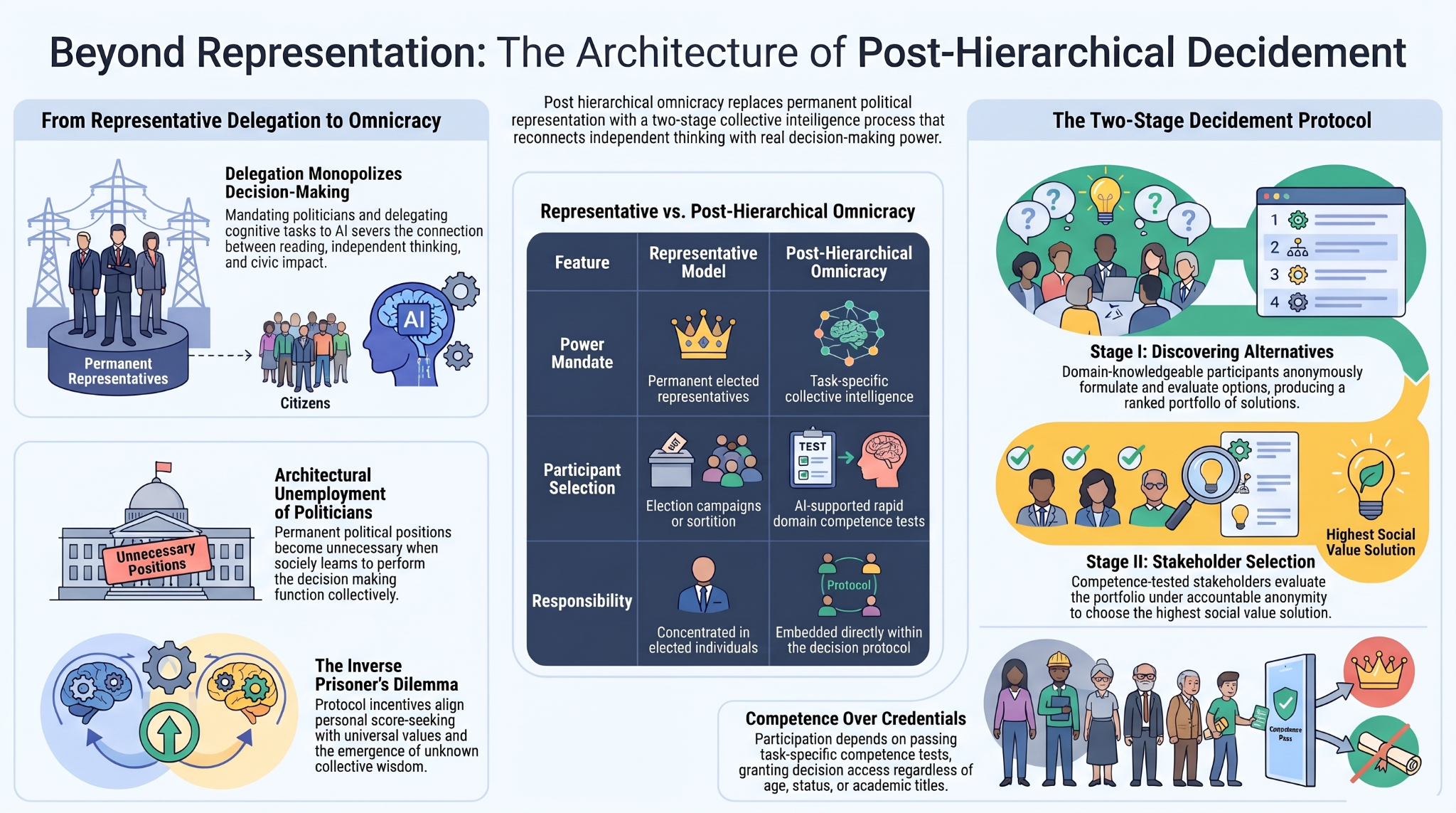
When Could Professional Politics Become Unnecessary?
The mere possibility of society deciding without permanent representatives does not establish that such decidement would be better. Essay No. 240 postulates an important condition: architectural change would depend on demonstrable decision quality. [3] If collectively discovered alternatives and stakeholders’ choices consistently generated greater long-term social value, the need for professional political intermediation would diminish. This would not mean excluding people from politics, but bringing them back into the creation of shared life.
Society would still need to decide how to allocate resources, protect rights, reconcile conflicting interests and determine its future direction. However, the competence of a teacher, doctor, engineer or artist would become relevant whenever the corresponding question arose. They would not need to become politicians merely to ensure that their knowledge could influence a decision. Experience accumulated in politics would not lose its value either: it could be drawn on without an exclusive right to decide for others.
Another paradox lies here. Decisions sometimes create new problems that later require other decisions to correct them. Publication No. 240 calls this . [3] Higher-quality decidement could reduce the need for such activity. Post-hierarchy would therefore seek not to multiply society-wide deliberations but to help society better resolve the issues that genuinely need to be resolved.
This hypothesis also matters culturally: a person would not need to turn their entire life into political activism. The opportunity to engage where their knowledge or experience is valuable and withdraw when the task is complete would leave more time for learning, creativity and living relationships. Nevertheless, both the advantage in decision quality and the potential reduction in corrective decisions must be tested empirically rather than treated as predetermined results of the technology.
Social Ethics: From Moral Exhortation to Incentives for Interaction
Can an environment be created in which it is advantageous for people to try to evaluate another person’s idea impartially? This matters because good intentions alone are insufficient for social progress. In electoral competition, it can pay to magnify differences; in the attention economy, it can pay to provoke outrage. Both mechanisms can reward behaviour whose consequences are detrimental to society.
In both stages of omnicratic decidement, the organizes different incentives. A participant earns points for valuable contributions and for the correspondence of their evaluations with the emerging collective assessment. Since they do not know the other ratings in advance, can provide an orientation: try to evaluate as though one’s judgment formed part of a universally applicable norm rather than expressing a narrow interest. Kant’s principle of universalization and the Golden Rule are closely related here: would I want decisions to be evaluated on the same principle if I myself, my loved ones or people whose circumstances I cannot foresee today were to experience their consequences?
In Stage I, the ideas submitted by participants themselves are evaluated; in Stage II, the alternatives discovered in Stage I are evaluated. Both stages use the same rating principle: from −5 to −1 or from +1 to +5. Zero is not an expression of indifference, but indicates a breach of protocol, for example when an idea is duplicated, off-topic, unclear or reveals the author’s identity. Zero must not be assigned to an unpopular idea. On the contrary, unconventional alternatives that receive different assessments may enrich decidement.
People evaluate; algorithms calculate. The algorithm does not determine whether a person is honest or their idea objective. It does not create psychological models of participants. It calculates the results of human evaluations, individual scores and specialization weights according to shared rules. must arise from participants’ interaction rather than from an answer predetermined by the algorithm.
This is the essence of the inverse prisoner’s dilemma: in the ordinary prisoner’s dilemma, individually rational self-interest may produce a poor collective outcome, whereas the collective decidement protocol seeks to make the pursuit of personal benefit an incentive for socially oriented evaluation. Participants have no preannounced correct answer towards which they can mechanically orient themselves, nor are they encouraged to imitate an authority’s opinion. Collective wisdom emerges within the interaction itself. It cannot be equated with either a majority opinion known in advance or an AI prediction.
Would the Problem of Political Responsibility Disappear in Collective Decidement?
In a hierarchical order, the question of who is responsible for a decision is unavoidable: some people are entrusted with the right to decide for others, while others bear the consequences of their choices. Because decision-making authority is concentrated, responsibility must be concentrated with it. Elections, dismissal, oversight and sanctions, among other functions, are intended to reduce the risk that decision-makers will use their power against the public interest. Yet establishing responsibility after a harmful decision does not eliminate its consequences.
In post-hierarchy this question is raised before the decision is made: can a decidement architecture be created in which irresponsible evaluation is disadvantageous to the individual? The inverse prisoner’s dilemma principle is intended precisely for this. If both stages of collective decidement operate according to the protocol’s assumptions, a participant’s interest in obtaining the best possible personal score coincides with the incentive to evaluate rationally, consistently and in accordance with universal values. Under such conditions, a discriminatory decision privileging one group at the expense of another, or a decision shifting harm onto nonparticipants, future generations or nature, cannot be regarded as an expression of collective wisdom. It contradicts the very evaluative principles according to which that wisdom must emerge. In the idealized omnicracy model, if the protocol ensures this alignment of incentives and universal values, irresponsible and discriminatory decisions could not be selected—not because an external censor prohibited them, but because of participants’ own rational evaluations.
Environmental protection is not an additional interest that the most vocal interest group must defend. The capacity to evaluate universally includes the ability to recognize value and consequences where those affected cannot themselves participate. If, for example, destroying a rare ecosystem were economically advantageous to all current participants in decidement, that convergence of interests would not yet constitute collective wisdom. A solution’s value must be assessed independently of whether those who benefit and those who suffer harm are sitting at the same virtual table.
The theoretical conclusion of this model is that the question of individualized political responsibility for a collectively chosen solution loses its meaning. No participant has the privilege of determining the result unilaterally, and no one can be appointed to answer for the choice that emerged through the entire interaction. Responsibility is not left to the conscience of an elected individual; it is built into the protocol itself. Collective wisdom does not arise by granting one person the right to decide and then requiring them to behave responsibly.
It is important to distinguish the normative conclusion of the model from a claim that a real system is infallible. Alignment of incentives with universal values is a necessary assumption of the protocol, not an empirically established guarantee that no real group of participants can make mistakes, collude to abuse the system or rely on erroneous data. A decision made in good faith may prove unsuitable because of insufficient knowledge or changed circumstances; in that case, it matters to correct the decision rather than seek someone to blame for the entire decidement outcome. Pilot projects should test whether the incentives actually discourage bias, discrimination and harm to nature. Until the system’s reliability has been demonstrated, protection of existing rights and lawful review of decisions remain necessary.
Implementers’ responsibility for whether they carry out the selected decision, comply with its conditions and legal requirements and properly use entrusted resources does not disappear either; breaches of the protocol do not become exempt from accountability. The difference is that implementing a decision is not a privilege to decide otherwise, and responsibility for specific actions is not equated with the search for political blame over an anonymously and collectively formed choice. Existing legal responsibility cannot be abolished merely by introducing a platform.
Responsibility would not need to be demanded of a person entrusted with power if the very architecture of decidement encouraged everyone to evaluate responsibly.
Not Every Disagreement Is Social Division
Collective decidement is not meant to produce people who all think alike. On the contrary, different experiences are among its most important resources. The problem begins when disagreement over an idea turns into a relationship between hostile groups. If a proposal is inseparable from the identity of the person who submitted it, rejecting the idea may mean rejecting the person, while accepting a good idea from an opponent may mean betraying one’s own camp.
Accountable anonymity allows these things to be separated. A person may give a high rating to an idea whose author they would never support in public polemic. They may reject a weak argument from their own group without facing personal pressure or retaliation for a particular evaluation. Anonymity here does not replace living human connection. It removes the obstacles of status and identity in a very specific activity: the search for a solution.
Polarization of ratings is not the same as social polarization. The former may help reveal a problem; the latter may obstruct its examination. When evaluations diverge, rather than declare winners and losers, a new decidement task can be initiated: what alternatives would address the problems revealed by both positions?
AI: Not Less Technology, but a Different Purpose for Technology
Technologies can act as substitutes for human thinking or as means of extending it. The distinction is determined not merely by the size of a screen or time spent in front of it. It depends on which cognitive activity people themselves undertake.
If AI provides the final answer and the human being can only accept it, a new cognitive hierarchy arises. If AI helps locate facts, translate texts, compare scenarios or check calculations, while the right to evaluate and choose remains with people, technology can extend the operational possibilities of collective intelligence. Data and models supplied by AI must be checked and their uncertainty made clearly visible.
From the post-hierarchical perspective, this is symbiosis: collective intelligence discovers a value-based direction for action, while artificial intelligence helps explore possibilities and implement chosen solutions. A digital environment is necessary for such interaction, but its aim is a better life for real people, not relocating their lives to a screen.
What Would This Look Like When Addressing a Real Problem?
The interview raises the issue of resources used by data centres and the interests of local communities. [1] Suppose such a centre is proposed in a Lithuanian municipality. The investor promises jobs, the municipality expects revenue, and residents are concerned about electricity, water and the landscape. A conventional discussion may quickly become a conflict between proponents of investment and defenders of the environment.
would begin not by asking which camp will win but with a specific task:
Which alternatives for building, operating or foregoing a data centre would create the greatest long-term social value without imposing an unacceptable burden on residents and nature?
- Verifiable initial knowledge is gathered. Assessments of water, electricity, environmental impact and jobs, along with their assumptions and uncertainties, become available to participants.
- Stage I – decidement by people knowledgeable about the issue. Energy specialists, hydrologists, ecologists, economists, engineers and people familiar with local conditions propose and evaluate alternatives on a single platform: another location, a smaller scale, a closed-loop cooling system, waste heat recovery, abandoning the investment or other solutions. These are examples, not a predetermined menu of choices.
- Stage II – collective decidement by stakeholders. Anyone who has passed a short AI-supported competence test in the relevant domain may join: a local resident, an employee of the investor, someone interested in water resources or a school pupil. They anonymously evaluate the entire portfolio of alternatives, striving to align as closely as possible with the collective wisdom that is only now taking shape. The pursuit of the highest score encourages rational and universal evaluation, going beyond personal benefit: for instance, considering the impact of water use on downstream residents, future generations and ecosystems. The choice emerges from collective evaluations rather than from the numerical superiority of interest-group votes.
- The choice is implemented and evaluated. Responsible institutions and implementers carry out the lawful decision, and actual measures of resource use and social benefit become the basis for the next decidement cycle.
During a transitional phase, the municipality could undertake in advance to consider the outcome of collective decidement publicly, justify any departures from it and implement the choice within the limits of the law. Full omnicratic decidement would require a legally established opportunity for those who pass the competence assessment to make the final decision collectively, together with conditions for its implementation and review. A pilot project would not yet constitute full omnicracy, but would allow its operating assumptions to be tested empirically. In comparing modes of decidement, one should assess not only participant satisfaction but also actual impacts on resources, human welfare, rights and the need for subsequent corrective interventions. This would test the hypothesis of architectural change put forward in publication No. 240.
Literacy Would Be Cultivated Not Only by Schools, but by Society Itself
If the ability to read and write matters for shared life, schools should provide a space not only for learning about politics but also for practising decidement. Pupils might, for example, decide how to reduce bullying or make more meaningful use of school spaces: read sources, formulate one proposal at a time, evaluate others’ ideas and test the impact of the chosen measure. In a school pilot, adults would ensure safety and protect rights, while pupils would experience how an argument can change reality. The principle of full post-hierarchy is broader still: the right to participate in a particular decidement task would depend on actual competence rather than age. Learning would be worthwhile also because acquiring knowledge would give a person the opportunity to take part in real decisions.
The same principle can be applied in libraries, cultural centres and communities. A library could become not only a repository of information or a place to read, but also accessible infrastructure for collective decidement—helping people understand tasks, find sources and participate regardless of digital skills. In-person encounters, reading literature and digital interaction would not be competitors. Rapid competence tests in this environment would be not final examinations but open gateways to deciding particular issues: learning would enable participation, and practising decidement would encourage further learning. The test would not replace human thinking; human thinking would open the possibility of participation.
If people know that a text they have read, an argument they have discovered or an error they have noticed may help their community choose a better solution, reading acquires additional social meaning. This is no guarantee that everyone will become an avid reader. But a new motivation for thinking emerges—not to understand better a decision others have made on your behalf, but to contribute to discovering it yourself. The diminishing role of professional politics and the strengthening of society’s cognitive capacities could thus become mutually reinforcing rather than opposing processes. This connection should be investigated by observing whether meaningful decidement practice really encourages people to study sources in greater depth, formulate ideas more precisely and evaluate others’ proposals more attentively.
Conclusion: Democracy’s Successor Should Cultivate People Who Can Decide
Antanavičiūtė’s warning opens up one of the most important problems of this century: a society cannot be free if it loses its capacity for independent evaluation. But defending reading and writing while leaving the structure of decision-making power unchanged is not enough.
From the post-hierarchical perspective, representative democracy is not the final form of society’s political evolution. Omnicracy’s ambition is to preserve freedom, human dignity and the right to participate while overcoming the necessity of permanently delegating decisions to political professionals. The decline of professional politics in this model would not be a reform pursued for its own sake, but a possible consequence of better decidement. If this advantage were confirmed, society could not only regain decision-making power but also reduce the need to correct problems caused by its own decisions.
Collective intelligence at both stages would connect competence, universal openness to learning and individual motivation to evaluate according to universal principles. If the incentives of the inverse prisoner’s dilemma functioned as envisaged by the model, responsibility would become a property of the decidement process rather than a virtue of people vested with individual decision-making power that must be demanded after every failure. This is not simply a project for more efficient governance. It is a cultural project in which people’s ability to think together becomes a condition for the functioning of society itself. The question raised by Antanavičiūtė—how to preserve a thinking citizen—would then become a question of how to create a society that needs that capacity every day.
Teaching a person to think is not enough if they are not allowed to decide. We need a society in which thinking is worthwhile because how we will live depends on it.
From Delegated Thinking to Collective Decidement
flowchart TD
 A["Cognitive crisis of democracy"] --> B["More power to citizens"]
 B --> C{"How is decidement<br/>organized?"}
 C --> Q["Reform of<br/>representation"]
 Q --> D["Citizens’ assembly<br/>selected by lot<br/>(H. Landemore, 2026)"]
 C -->|"Post-hierarchical model"| E["Stage I: experts develop<br/>and evaluate alternatives<br/>using CI"]
 E --> F["Ranked portfolio<br/>of alternatives"]
 P["Both stages: inverse<br/>prisoner’s dilemma.<br/>Align with collective wisdom<br/>using universal principles."] --> E
 P --> G
 F --> G["Stage II: collective intelligence.<br/>Anonymous evaluation<br/>of alternatives and<br/>choice of solution"]
 T["Rapid AI-supported<br/>domain competence<br/>test. Open to all,<br/>regardless of age or<br/>status."] --> G
 G --> R["Ratification and<br/>transfer to<br/>implementers"]
 R --> H["Implementation and<br/>assessment of<br/>consequences"]
 H -.->|"Feedback"| E
 G -.-> I["Motivation to read,<br/>write and think may<br/>strengthen<br/>(Effective literacy)"]
 H --> J["If a quality advantage<br/>is demonstrated in<br/>practice"]
 J -.-> K["Need for political<br/>intermediation and<br/>individualized political<br/>responsibility may diminish<br/>(Architectural unemployment)"]
 J -.-> L["Need for corrective<br/>decisions may diminish<br/>(Decline of parasitic<br/>decision multiplication)"]
 classDef conventional fill:#f3f1ec,stroke:#9b978f,color:#25261f
 classDef post fill:#fff8f4,stroke:#a93b2b,color:#25261f,stroke-width:2px
 classDef outcome fill:#f8f4ed,stroke:#a93b2b,color:#25261f,stroke-width:1.6px
 classDef shared fill:#e8eee4,stroke:#73866a,color:#25261f,stroke-width:1.8px
 class A,B,C,Q,D conventional
 class E,F,G,R,H,J post
 class I,K,L outcome
 class P,T shared
Sources and Links
- Vita Vilimaitė Lefebvre Delattre, interview with Marija Antanavičiūtė. “Antanavičiūtė on social division: when we stop reading and writing, democracy will collapse”. LRT.lt, 2026-11-22. Source analysed (Lithuanian).
- Hélène Landemore. Politics Without Politicians: The Case for Citizen Rule. Thesis (Penguin), 2026. Book presentation on Yale University’s website.
- Post-Hierarchy Papers, No. 240. When Politicians Become Unemployed: Why Collective Intelligence May Render Professional Politics Obsolete. LinkedIn, 2026-11-27. Conceptual essay on architectural unemployment, omnicracy and the potentially diminishing need for professional politics.
- culture.lt. “When Democratic Discourse Becomes a Struggle, Who Can Change the Rules of the Game?” Post-hierarchical analysis 018. Related text on the inverse prisoner’s dilemma, the collective-intelligence principle applied in both stages, and incentives for decidement (Lithuanian original).
- Omnicracy. The collective decidement platform and technological approach discussed here.
- culture.lt. “Who Will Free Creativity from Conformity?” Post-hierarchical analysis 020. Related text on the reversal of incentives and orientation towards collective wisdom unknown in advance (Lithuanian original).