POST-HIERARCHY ATLAS · 001
Who Decides What Culture Becomes?
From Cultural Gatekeeping to Collective Intelligence
? Dotted terms can be clicked for a short explanation.
Imagine someone with an idea for a film, a performance, a book, an exhibition, a musical work, or a new cultural form. Today, that idea will often travel toward an institution and an expert committee. In a post-hierarchical system, the project could take another route: not through a single gate, but through a deliberately organized process of collective intelligence.
SHORT EXPLAINER · 1 MIN 22 S
How collective intelligence funds culture
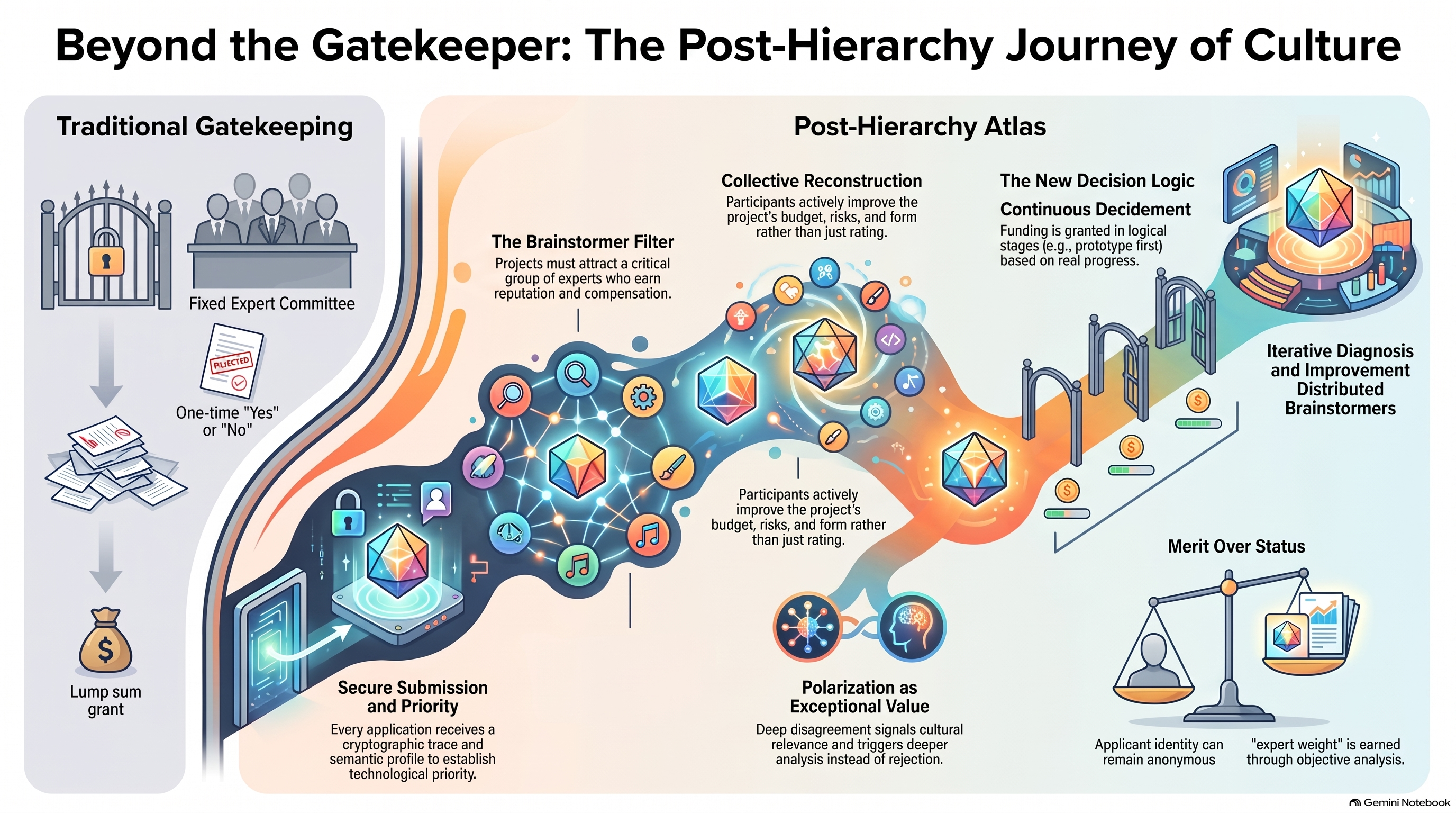
This short video explains why funding should follow the real development of a cultural project rather than a one-time gatekeeping verdict. In a post-hierarchical model, a project is collectively improved, evaluated in context, and financed in logical stages tied to actual progress.
- A project is not simply approved or rejected by a fixed committee; it is examined and improved by a distributed group of relevant participants.
- Collective reconstruction helps refine the project’s form, budget, risks, and timeline before larger commitments are made.
- Funding can proceed in stages — for example prototype first, production later — instead of relying on a single lump-sum grant.
- Influence is earned through demonstrated judgment and contribution, not through institutional status alone.
- An idea becomes an applicationThe creator explains what they want to make, why it matters, what resources are needed, and what result is sought.
- The idea receives a priority recordThe system records submission time, a cryptographic trace, and the semantic profile of the proposal.
- The application must attract a critical analysis groupBrainstormers join when they see project potential and are ready to contribute to the analysis, building expert weight, earning CI currency, and receiving financial compensation according to their real contribution to the final result.
- The project is collectively improvedThe idea, form, budget, duration, risks, dissemination, stages, and funding model are all open to analysis.
- Funding follows the logic of realizationResources may be granted at once or in stages, depending on what the analysis finds most reasonable.
- The result returns to the systemProgress is assessed between stages, and a completed work may later enter a new process for translation, circulation, presentation, or preservation.
1. An application becomes an entry into a process
The creator uploads the project to a dedicated cultural-project platform. They may choose whether their identity is visible from the beginning or remains anonymous during part of the evaluation. The logic of evaluation should not change: the primary object is the proposal itself.
From the moment of submission, the system records time and a digital trace of the application. This is not a legal patent, but a : it becomes possible to show when a particular idea was submitted and what it contained at that moment.
AI can compare new applications with previously registered ones and flag or temporarily block a highly similar submission for additional review. This reduces the possibility of appropriating someone else’s idea merely by rewriting it in different words.
2. The first filter: does the project attract enough brainstormers who see its potential?
The application does not automatically go to a permanent committee. The system waits until a critical group of participants—here called —forms around it.
A brainstormer is not a volunteer donating an irreplaceable resource — time — to the review of applications. By participating, the brainstormer accumulates , earns , and receives financial compensation linked not simply to time spent, but to their real contribution to the final result.
Joining a specific project is therefore both a professional and reputational choice. A brainstormer decides where their competence is worth directing. The willingness to join becomes a signal of the project’s potential, while the incentive architecture encourages participants to make their analysis, proposals, and evaluations as valuable to the collective process as possible.
One possible reputation mechanism is that repeatedly joining applications that fail to attract the required slightly reduces a participant’s expert weight. This encourages brainstormers not to register mechanically for as many projects as possible, but to select those in which they genuinely see value and where their competence can be useful.
The collective-intelligence process is designed so that valuable ideas are noticed and amplified regardless of whether they are familiar, experimental, radical, risky, or difficult to classify. Novelty is neither an advantage nor a defect in itself. If brainstormer evaluations polarize, that is not a reason to suppress the project or place it in a special “protected” category. On the contrary, polarization diagnoses exceptional cultural value and relevance: the project has touched a strong contradiction that the cultural field has not yet resolved. Such a project should be analyzed more deeply, not rejected. One of culture’s functions is to bring contradictions into the open and help work through them before they begin to harm society.
3. “No” becomes diagnosis rather than verdict
If the required group never forms, the application does not receive a permanent rejection. The creator may improve it and submit again after a defined interval. At the same time, the system should prevent the platform from being flooded by repeated versions of essentially the same low-value proposal.
If analysis has begun but participants identify serious weaknesses, they should specify what should change: the idea, scope, budget, duration, team, technology, audience, or dissemination model.
If assessments polarize, that is a different situation. The project is not rejected because consensus failed to appear. Instead, the contradiction itself becomes an object of analysis.
The rejection of a weak project becomes diagnosis. Polarization becomes a diagnosis of exceptional value and relevance.
4. Brainstormers evaluate the architecture of the project, not only its “quality”
A traditional grant application often arrives as a finished package: concept, budget, timeline. The committee mainly decides whether to fund that package.
In a post-hierarchical process, the questions are broader. Brainstormers can examine:
- whether the project is worth realizing at all;
- what its strongest form could be;
- what budget is actually justified;
- how long realization should take;
- which intermediate results should be checked;
- whether funding should be granted at once or in stages;
- which competences are missing from the team;
- how dissemination should be organized.
The project is therefore not merely rated. It is collectively reconstructed toward the strongest version the group can identify.
5. Funding becomes continuous decidement
If the project is recognized as valuable, brainstormers do not necessarily assign one final amount and leave. They can construct the funding scenario itself.
A screenplay or prototype might be funded first. Production could follow after an intermediate result. Dissemination could become a later stage. In another case, granting the full amount immediately may be more rational. No single pattern needs to be mandatory.
Accountability follows the logic created during analysis. Continued funding depends not simply on whether a formal report was filed, but on what the previous stage actually produced.
6. A name may be visible, but status does not become a vote
The applicant may remain anonymous or disclose their identity. Reputation can be relevant factual information about a creator’s ability to complete a project, but it should not automatically become a stronger claim on funding.
The brainstormer’s task is not to defend a favorite. It is to evaluate proposals as accurately as possible. This creates what we call, metaphorically, a : if I expect others to evaluate ideas as objectively as they can, it becomes rational for me to do the same.
The target is not a visible majority opinion. It is an unknown that emerges only through the process.
7. The cultural field can be wider than the state
A Lithuanian project does not necessarily need to be examined only by Lithuanians. For some projects, local cultural knowledge is decisive. Others require an international perspective from the start.
At the beginning of the analysis, participants can decide what proportion of the group should come from other countries. One project may need almost none; another may benefit from one fifth or one third of the group being international.
The international share then becomes not an administrative quota, but a parameter derived from the project’s actual analytical needs.
8. A completed work can enter the system too
Post-hierarchical cultural infrastructure does not need to deal only with future creation. A writer may already have written a book, a filmmaker may have completed a film, a musician an album, an artist an exhibition.
The new project may then concern the work’s further life. Should it be translated? Shown in other countries? Digitized? Published more widely? Connected to an educational program? Preserved or archived?
The logic remains the same: collective intelligence does not merely issue a verdict that the work is “good” or “bad.” It searches for the most meaningful next action.
9. Test the mechanism before institutionalizing it
Such a system does not have to begin inside a ministry or a new public agency. Early stages could be financed by an independent fund, philanthropy, business, private supporters, or a combination of sources.
This makes it possible to begin as a controlled experiment: observe how groups form, whether collective evaluations stabilize, how polarization behaves, what kinds of projects move through the process, how staged funding works, and what cultural results are eventually produced.
If the mechanism proves itself, public institutions can later connect to an operating infrastructure rather than first building a bureaucracy and only afterwards asking whether it works.
One possible journey of a cultural project in a post-hierarchical system
flowchart TD
 A["Idea"] --> B["Application on the platform"]
 B --> C["Time stamp and technological priority record"]
 C --> D{"Does a critical brainstormer group form?"}
 D -- "No" --> E["Feedback / waiting period / project improvement"]
 E --> B
 D -- "Yes" --> F["Collective project analysis"]
 F --> G["Idea + form + budget + duration + risks + dissemination"]
 G --> H{"What does the evaluation show?"}
 H -- "Insufficient value" --> E
 H -- "Clear value" --> I["Funding and accountability scenario"]
 H -- "Polarization" --> P["Deeper analysis of the contradiction"]
 P --> F
 I --> J["Realization stage"]
 J --> K{"Continue funding?"}
 K -- "Revise" --> F
 K -- "Yes" --> L["Work / project result"]
 L --> M["Dissemination / translation / presentation / preservation"]
 classDef start fill:#e9e5dc,stroke:#6f6d66,color:#191916
 classDef process fill:#f4f1ea,stroke:#6f6d66,color:#191916
 classDef decision fill:#fff,stroke:#a93b2b,color:#191916,stroke-width:2px
 classDef outcome fill:#f4f1ea,stroke:#a93b2b,color:#191916,stroke-width:2px
 class A,B,C,F,G,I,J start
 class E,P process
 class D,H,K decision
 class L,M outcome
Culture after hierarchy
This model does not mean that every creator must use the platform. People remain free to create with their own resources, publish online, find a private patron, sell directly to an audience, or choose any other route.
A post-hierarchical system creates an additional infrastructure for projects that require shared resources and a collective decision.
Not a gatekeeper, not an algorithm, and not an anonymous crowd, but deliberately organized collective intelligence can decide which cultural ideas deserve shared resources—and help those ideas become real.
The next Post-Hierarchy Atlas articles will reveal the individual mechanisms of this architecture: how brainstormer groups form, how collective evaluation works, what polarization means, how contribution is accounted for, how projects are constructed, and how funding decisions are made.