POST-HIERARCHICAL ANALYSIS · 013
Can an Institution of Care Remain Hierarchical?
A post-hierarchical analysis of Renata Petrauskaitė-Juodeikė’s “Posthumanist Bestiaries for Friendship and the Rumbles of Militarization”
Terms marked with ? are explained without leaving the article.
A contemporary art institution may embrace care, friendship, otherness, and co-creation while leaving its decision-making center intact. The post-hierarchical break begins not when a hierarchy selects more sensitive themes, but when participants gain a real capacity to shape the program, selection, and allocation of shared resources.
Source: Šiaurės Atėnai
SHORT EXPLANATION · 1 MIN 16 SEC
Why do caring institutions remain hierarchies?
In a conventional art institution, a closed circle of directors and curators selects the themes and artists, while visitors enter a program already designed for them. A post-hierarchical model does not replace curatorial competence with a popularity contest; it places that competence inside a broader collective-intelligence environment.
- Artists, curators, staff, and audiences propose and evaluate alternatives in one system.
- Ideas are assessed separately from the author’s office, fame, or institutional status.
- The results reveal both the strongest directions and genuine disagreements.
- Leadership may retain final responsibility, but its choice becomes open, reasoned, and testable.
From hermeticism to care
Renata Petrauskaitė-Juodeikė reads several recent exhibitions at the Contemporary Art Centre in Vilnius (CAC) as signs of a shift in the institution’s curatorial thinking. The images of hermeticism, elitism, conceptualism, and distance that once accompanied the CAC are giving way to the themes of care, generosity, friendship, otherness, and coexistence.
The international exhibition “Superglue, or How to Make a Friend” is presented as the beginning of a new CAC phase. Hybrid human and nonhuman figures become a space for posthumanist imagination in which symbiosis, interspecies coexistence, and —making-with others—can be explored.
The exhibitions “Bells and Cannons: Contemporary Art in the Face of Militarization” and “Walls Are Nocturnal Animals” mark another change. An institution that had avoided direct political discourse now responds more explicitly to war, militarization, colonialism, and invisible forms of power.
Context: an art institution is not a neutral container
An art institution does more than display completed works. It determines what becomes visible, which questions enter public discussion, which experiences are recognized, and which futures become imaginable. A curatorial shift is therefore more than a change of exhibition themes: it redefines the institution’s relationship with artists, staff, audiences, and political reality.
Care here is not merely personal benevolence. It becomes a curatorial category concerned with durable relationships, vulnerability, and dependence on others. A posthumanist perspective also weakens the myth of the autonomous person and the solitary author: a work, an institution, and even the human subject emerge through relations with other people, species, materials, technologies, and environments.
What should be preserved from the essay
The author does not idealize either the new curatorship or political art. She asks whether moving images of war into the safety of an art space neutralizes them, whether empathy becomes a diplomatically balanced set of acceptable positions, and whether political critique turns into an aesthetically attractive, marketable spectacle. This is a mature diagnosis: a system of power can be criticized in a way that leaves its structure untouched.
Where does the author’s argument end?
The CAC’s curatorial shift expands the imagination of care, friendship, interspecies coexistence, and political responsibility, while the risks of aestheticizing war, neutralizing criticism, and admitting invisible political influence remain.
We must examine not only which values an institution declares and which images it shows, but who is entitled to set the program, select artists, define legitimate perspectives, and allocate resources.
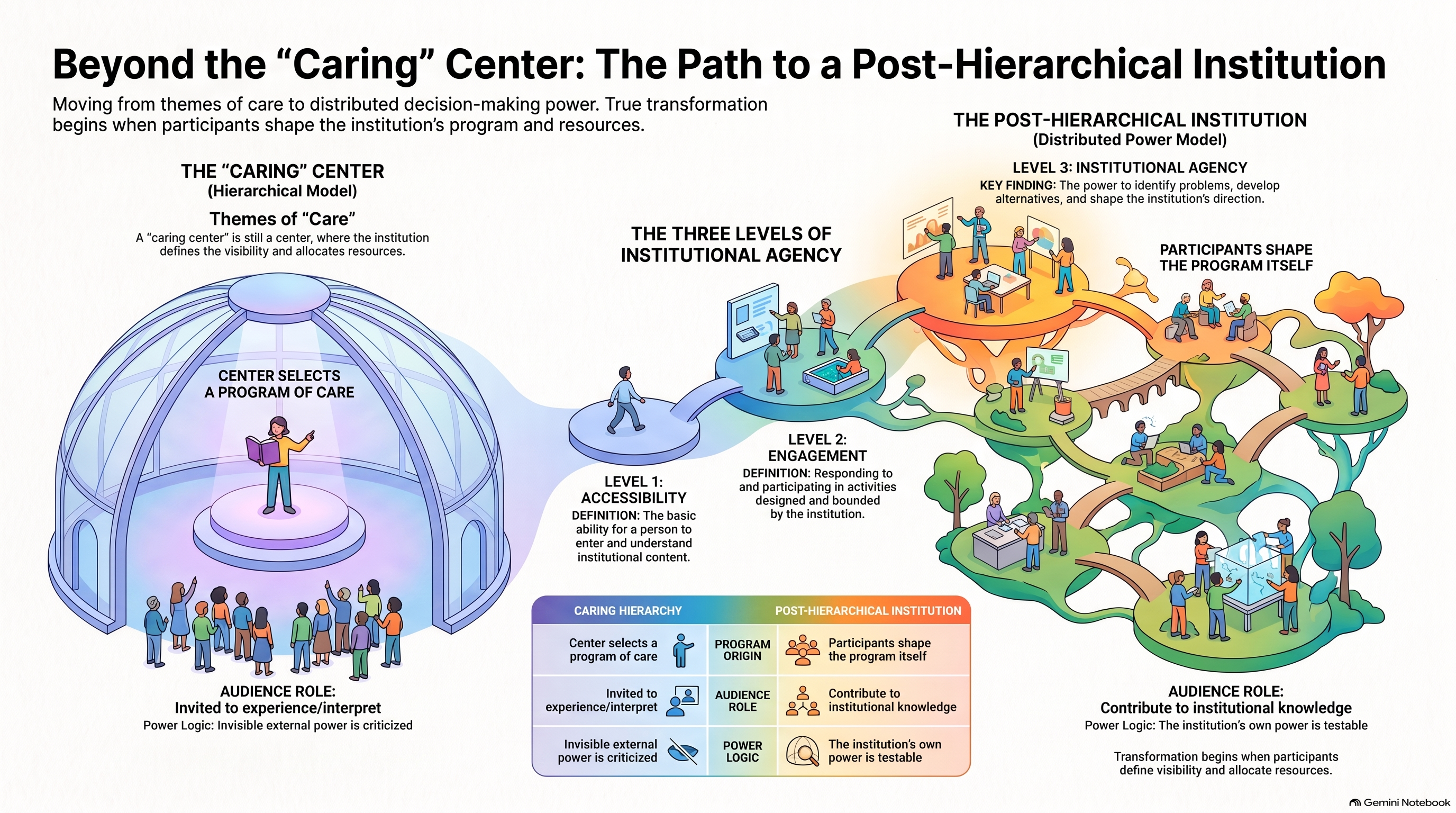
The post-hierarchical divide: a caring center is still a center
The shift described by Petrauskaitė-Juodeikė is important, but it is primarily a shift in curatorial programming. The institution chooses to speak about care, coexistence, marginalized experiences, war, and invisible power.
Who is entitled to decide that these particular themes, artists, works, and political perspectives will represent care, openness, and co-creation?
If the answer remains the same—the director, curators, and the professionals they select—the institution may become more sensitive, open, and intellectually courageous while its decision architecture remains hierarchical. A caring center is still a center.
Posthumanist or post-hierarchical content does not by itself create a post-hierarchical institution.
Two different institutions
| Caring hierarchy | Post-hierarchical institution |
|---|---|
| The center selects a program of care | Participants can shape the program itself |
| Curators decide whom to include | Problems and alternatives are formulated distributively |
| The audience is invited to experience and interpret | The audience can contribute to institutional knowledge |
| Marginalized groups are granted visibility | Affected groups help determine the conditions of visibility |
| Co-creation is an exhibition theme | Co-creation is a mode of decision-making |
| Invisible external power is criticized | The institution’s own selection power becomes visible and testable |
VIDEO ESSAY · 6 MIN 49 SEC
Care vs. hierarchy
A broader visual explanation of the difference between adopting care as an institutional value and changing the architecture through which cultural priorities, visibility, and resources are decided.
Audience engagement is not yet a distribution of power
An audience may be invited to enter, touch, listen, discuss, join educational activities, or share impressions. All this reduces institutional distance. Yet the visitor still enters an already designed environment whose theme, boundaries, selection of works, and interpretive vocabulary were established by others.
The contradiction noted in “Superglue” is revealing: the exhibition speaks of proximity and new relationships, yet the sculptures may not be touched. Visitors are invited to cross boundaries imaginatively, but not necessarily empowered to affect the system that sets those boundaries.
- Accessibility. A person can enter the institution and understand its content.
- Engagement. A person can respond, discuss, and participate in activities designed by the institution.
- Institutional agency. A person can help identify problems, develop alternatives, and shape institutional direction.
The first two levels can exist in a hierarchical institution. A post-hierarchical transformation begins only at the third.
Post-hierarchy is not majority taste
Distributing power does not mean assembling an exhibition program by public vote. Culture cannot be reduced to a survey and artistic value to popularity. Such a model would replace hierarchy with majority rule and platform ranking.
Art requires different kinds of expertise—artistic, curatorial, historical, technological, social, and ethical—as well as minority perspectives that may initially be unpopular or difficult. Post-hierarchy therefore does not abolish curatorial competence. It separates competence from a monopoly on decision-making.
A curator would not disappear. Their proposed direction would become one professionally argued alternative within a broader process of collective inquiry. The value of the contribution would depend not only on office but on the capacity to recognize important problems, valuable artistic directions, and connections others have missed.
How a post-hierarchical art institution could work
The CAC or another public cultural institution could maintain a continuous environment. Artists, curators, critics, researchers, staff, different audience groups, affected communities, and experts from other relevant fields would participate.
Participants would first evaluate existing ideas and then, if they had something new to add, submit one clear, non-redundant, original proposal. Authors would remain invisible during evaluation. Such would prevent fame, rank, or affiliation from directly determining a proposal’s weight.
The environment could reveal cultural problems the institution overlooks, emerging program directions, unseen creators, perspectives displaced by the dominant narrative, alternative resource-allocation models, and both agreement and reasoned .
The final decision need not be delegated automatically to an algorithm. But the institution could no longer rely solely on closed internal deliberation. It would see a structured collective-intelligence result and publicly explain why it follows or departs from it. Curatorial responsibility would not disappear; it would become more testable.
Political positions and the epistemic limits of a closed group
Invisible influence does not arise only when governments, sponsors, or international partners demand a preferred stance. It also operates when an institution does not reveal how themes, works, and interpretations were selected.
A curator may sincerely resist political conformity and still remain bounded by their informational and moral environment. Some perspectives appear self-evident, others dangerous, irrelevant, or insufficiently contemporary. This need not be corruption or deliberate manipulation. More often, it is the natural epistemic limit of a closed group.
Collective intelligence is therefore needed not only for democratic legitimacy but to expand what the institution can know. It can test whether an exhibition merely confirms a preselected political coordinate system, which reasoned positions are missing, whether juxtaposing conflicts enriches or neutralizes them, and whether audience disagreement reflects ignorance or a genuine moral tension.
From collective imagination to collective agency
The essay ends with hopeful directions: forming new relationships, expanding collective imagination, learning otherness, questioning, dissenting, resisting, listening, and cultivating practices of care. No alternative reality can emerge without the capacity to imagine it.
AUDIO ESSAY · 23 MIN 38 SEC
Collective imagination is not collective agency
A spoken exploration of the article’s central post-hierarchical distinction: imagining a less hierarchical world does not yet give people the institutional capacity to change the structures in which they participate.
Yet collective imagination is not collective agency. An institution may encourage people to imagine a world without dominant hierarchies while excluding them from decisions about its own operation. It may exhibit sympoiesis without itself being made-with others.
An institution of care becomes post-hierarchical not when the center begins caring for others, but when others gain a real capacity to shape what is cared for, what becomes visible, and how shared resources are used.
Conclusion: who decides what the institution will say?
Petrauskaitė-Juodeikė convincingly shows that the CAC is beginning to speak a different language: care instead of distance, interspecies entanglement instead of the autonomous human, and engagement with war and power instead of political detachment.
A post-hierarchical analysis takes one further step. It asks not only what the institution says, but who decides what it will say. Here lies the decisive divide between a new curatorial program and a new institutional order.
Where does the post-hierarchical divide emerge?
flowchart TD
A["Hermetic art institution"] --> B["Curatorial shift"]
B --> C["Care, generosity, and inclusion"]
C --> D{"Who sets the conditions of co-creation?"}
D -->|"Management and curators"| E["Caring hierarchy"]
D -->|"Distributed decidement"| F["Post-hierarchical institution"]
F --> G["Participants shape problems, alternatives, selection, and resources"]
classDef conventional fill:#f3f1ec,stroke:#9b978f,color:#25261f
classDef post fill:#fff8f4,stroke:#a93b2b,color:#25261f,stroke-width:2px
class A,B,C,D,E conventional
class F,G post